Originally from a Tweet thread published in 2017.
Shared folders are antithetical to collaboration and team information management.
The most responsible way to collaborate is through deliberate, individual file sharing that permits organizational autonomy.
Organizational autonomy should be default, shared spaces the exception.
Here’s why: Shared spaces are contracts, contingent on agreed-upon practices
As with work arrangements, ambiguities in the explicit terms and confusion on agreed-upon practices (i.e., no contracts) is a recipe for disaster.
Not saying it can’t be done, but it does have serious inherent risk, and explicitly defining terms has a high cost.
Creating and agreeing upon practices depends greatly on scale (how big something is), personal dispositions (likelihood of agreement), and options (how many different opinions will need to be reconciled).
In terms of scale, shared spaces can take different forms: Individual words, paragraphs, documents, and then hierarchy (documents and folders).
On a small team with agreeable dispositions, we can sort out a single paragraph easily. An entire document, less so. A hierarchy, with considerable difficulty.
Change the team size or personal dispositions, and that sequence becomes “somewhat difficult,” “hard,” and “impossible!”
To be honest, I think a team size greater than 2 will struggle in this way. Almost any team can likely work towards agreement on paragraphs and documents, but hierarchy is where everything goes off the rails.
So, let’s focus on hierarchy. Again, shared folders are bad news for effective collaboration. In fact, I think they increase chaos in an unhelpful way.
For #cynefin folks, I’m saying that shared folders are the simple/obvious answer to a complicated problem space, hence a chaotic outcome.
It’s a pretty straight-forward situation if you think about it. If you have an organizational system, it is personal in nature. And more often, there is no system, so chaos reigns. Your personal version of chaos is, by definition, not going to match anyone else’s.
So expecting a shared folder to reconcile however-many personal versions of chaos is absurd. Because chaos is normalized, coming to agreement on where things should be in a hierarchy is also absurd in all but the most trivial cases.
So if not shared folders, then what? I’m advocating for personal autonomy in hierarchy. By default: Share documents, but don’t share folders.
Personal autonomy requires less energy and creates flexibility, whereas agreement requires high energy and creates rigidity. If the tradeoff of energy for rigidity creates efficiency, then by all means consider agreement. But it probably won’t, so don’t.
Furthermore, since personal organizational systems are normally chaotic and disposition-driven, we have leaps and bounds to improve upon, because Good Practices are now available.
#PARA (via @fortelabs) is a Good Practice. Full stop. If you aren’t using a system like it for personal organization, then at this point you are actively harming your creative/executive ability.
And don’t tell me you thrive in chaos. Having witnessed typical experiences adopting #PARA, I just don’t think you are aware of what you don’t have. For 99.99% of you, it’s in your best interest to adopt Good Practice.
#PARA + shared documents (NOT shared folders) maximizes personal autonomy. It means you control how long a project populates your digital mind. You can contribute small changes without the permanence that normally accommodates participation.
A project’s visibility in your digital headspace does not need to be correlated with the actual timeline of a project, meaning flexibility in contribution and greater clarity.
Let’s say five people need to work on a client proposal — a dev, an operations person, a product person, an executive, and a lawyer. The shared workspace is a document (say, a Google Doc), but each manages their own organizational hierarchy.
At best, each individual utilizes and reaps the benefits of a Good Practice like #PARA. At worst, one individual’s organizational chaos does not affect anyone else.
With something like #PARA, each person can make a contribution without being tied to the project timeline. Say everyone starts the project. The folks who use #PARA create a new folder under Projects for it in their individual systems.
When there’s a lull, the project can be removed from individual visible work. For example, if the lawyer just needs a touchpoint at the beginning and the end, then in the middle they can just place the project folder in their #PARA Archives.
When they need to pick the work back up, the folder just moves from #PARA Archives to Projects — instantly back on the radar.
But most importantly, there is collaboration in a constrained space (the document) and no pollution from personal organizational systems chaos.
Right now it seems like Google Docs is best for this. Share individual documents, organize them yourself.
You could also use a shared folder with a flat hierarchy and just use symlinks/shortcuts locally (supported by all operating systems), but that might be a bit of a mess for the average contributor.
What do you think? Try this approach out and let me know what you experience. I’d love to see what I’m missing in the practical application of the theory. 🙃
Update 2022: Here’s a picture describing what I’m talking about
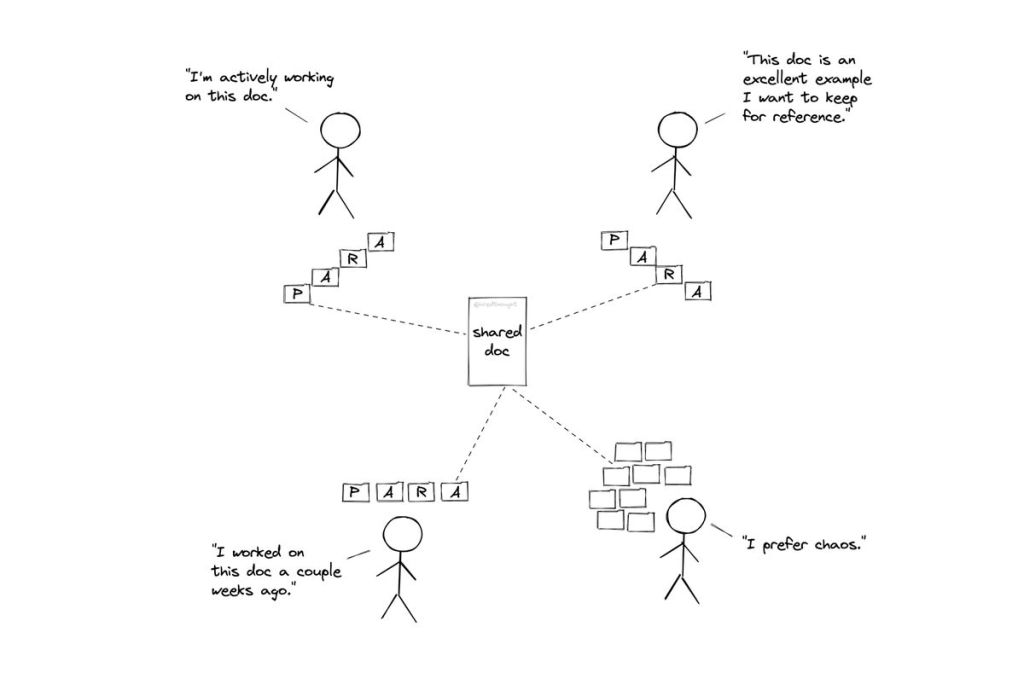
also, it’s funny re-reading this thread now. I’d use different language and probably do some more thinking about how to describe this in terms of a private / public / commons trichotomy.
 Hired Thought